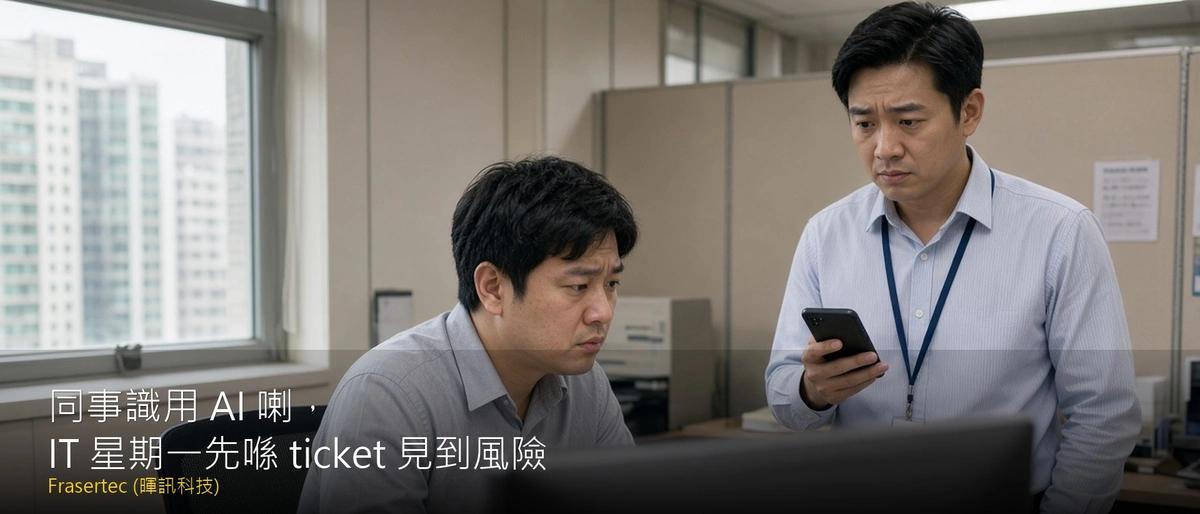
Your Employees Are More Eager Than You to Use AI! Ignoring "Shadow AI" Is Silently Devouring Your Company's Data
Lately, have you noticed some colleagues' work efficiency suddenly improving exponentially? Reports that used to take a whole day are now delivered in half an hour; marketing copy that used to be a headache now seems to pour out endlessly. You might secretly be pleased, thinking you've hired a 'superhero'. But have you considered that behind this mysterious force, there might be a massive risk capable of overturning your entire company?
This force is AI. And the AI tools your employees are using without your knowledge are the protagonist of today's discussion—'Shadow AI'.
What is 'Shadow AI'? A New Office Norm You Cannot Ignore
'Shadow AI' is not some new type of artificial intelligence, but a behavioral concept. It refers to employees privately using third-party AI tools and applications to handle work without the approval or knowledge of the company's IT department. This situation is consistent with what we often called 'Shadow IT'—where employees install software themselves or use personal cloud drives—but the potential destructive power of 'Shadow AI' far exceeds the former.
From ChatGPT, Gemini to various AI writing assistants, image generators, and code analysis tools, many of these AI services are free, easy to use, and incredibly powerful. For employees pursuing efficiency and wanting to 'run faster' in Hong Kong's rapid business environment, they are a godsend. They might just want to finish their tasks quicker or solve a tricky problem, but this 'convenience-seeking' mentality is unknowingly opening a Pandora's box of data leakage for the company.
Why Would Your Employees Secretly Use AI?
To solve a problem, first understand its root. Why would employees risk using 'Shadow AI'?
- Pursuit of Ultimate Efficiency: The Hong Kong workplace demands 'fast, good, and correct'. AI can draft emails, summarize meeting notes, translate documents, and even write simple code in seconds. For employees, this is a shortcut to boost personal productivity and leave work on time.
- Solving Urgent Problems: When faced with creative blocks, technical difficulties, or needing quick market research, AI provides an instant solution. Rather than waiting for a superior or another department to respond, asking AI directly provides answers on demand.
- Extremely Low Barrier to Entry: Most public AI tools only require a browser and an email address to register and use. No complex installation or professional IT knowledge is needed; employees can 'self-service' anytime, anywhere.
- Lack of Official Company Tools: Most importantly, many SMEs are slower in their digital transformation and have not provided employees with officially endorsed, secure, and reliable AI tools. When demand exists but supply is absent, employees will naturally seek solutions externally.
'Shadow AI': Sugar-Coated Poison, or a Double-Edged Sword?
'Shadow AI' is undoubtedly a double-edged sword. The efficiency gains it brings are real and visible, but hidden beneath the sugar coating is a potential poison that could 'wipe out your company in one go'.
Potential Risk One: Major Leak of Company Confidential Data
This is the biggest and most fatal risk. When your employee copies and pastes an entire document containing customer data, financial statements, product development blueprints, or internal pricing strategies into a public, free AI model for 'polishing' or 'summarizing', imagine what happens?
The terms of most free AI services clearly state that they have the right to use the data you input (prompts and uploaded materials) to train and optimize their models. In other words, your company's secrets instantly become 'nutrients' for the AI developer. This data might be stored permanently or even inadvertently leaked in other users' query results.
This behavior is not just a commercial leak; it could also violate Hong Kong's Personal Data (Privacy) Ordinance (PDPO), leading to serious legal consequences and fines.
Potential Risk Two: A Ticking Time Bomb for Cybersecurity
How do you know if the AI plugins or applications employees randomly find online are safe? Many malicious software programs disguise themselves as useful tools. Once installed, they can implant trojans, ransomware, or quietly steal employee login credentials within your company network, opening a convenient door for hackers.
Potential Risk Three: Decision-Making Errors Stemming from 'AI Hallucination'
AI is not omnipotent; they sometimes experience so-called 'AI Hallucination', meaning they will 'fabricate' information that looks perfectly reasonable but is completely wrong with a straight face. If employees overly rely on data or analysis provided by AI without fact-checking and make business decisions based on this misinformation, the consequences could be unimaginable.
I'm an SME Owner, What Can I Do? Frasertec's Professional Advice
Facing the silent threat of 'Shadow AI', an outright ban is not a feasible method. Doing so will only drive employees towards more covert methods while also stifling the opportunity to use AI to enhance innovation and efficiency. As an SME decision-maker, what you need is 'channeling', not 'blocking'.
Drawing on years of experience serving Hong Kong SMEs, Frasertec Limited provides the following four coping strategies:
1. Accept Reality and Develop a Clear AI Usage Policy
First, acknowledge that AI is already part of our work. Rather than pretending not to see it, sit down with your team to develop a set of clear, actionable AI usage guidelines.
- What is permissible: For example, using AI for public research, brainstorming.
- What is strictly prohibited: For example, inputting any sensitive information such as customer data, personally identifiable information (PII), financial data, or internal company documents into any public AI model.
- Usage rules: Emphasize that all AI-generated content must be manually reviewed and fact-checked.
2. Employee Education and Ongoing Training
Your greatest asset is your employees, but they can also be your biggest risk source. Regularly conduct workshops to educate employees about the risks of 'Shadow AI', explaining the reasons behind company policies. Teach them how to distinguish safe from unsafe tools and how to leverage AI to improve work efficiency under safe preconditions.
3. Deploy Enterprise-Grade, Secure, and Controllable AI Solutions
Instead of letting employees 'find their own way' externally, provide a safe, unified 'official' choice from the company. There are now many AI solutions designed specifically for enterprises, such as Microsoft 365 Copilot.