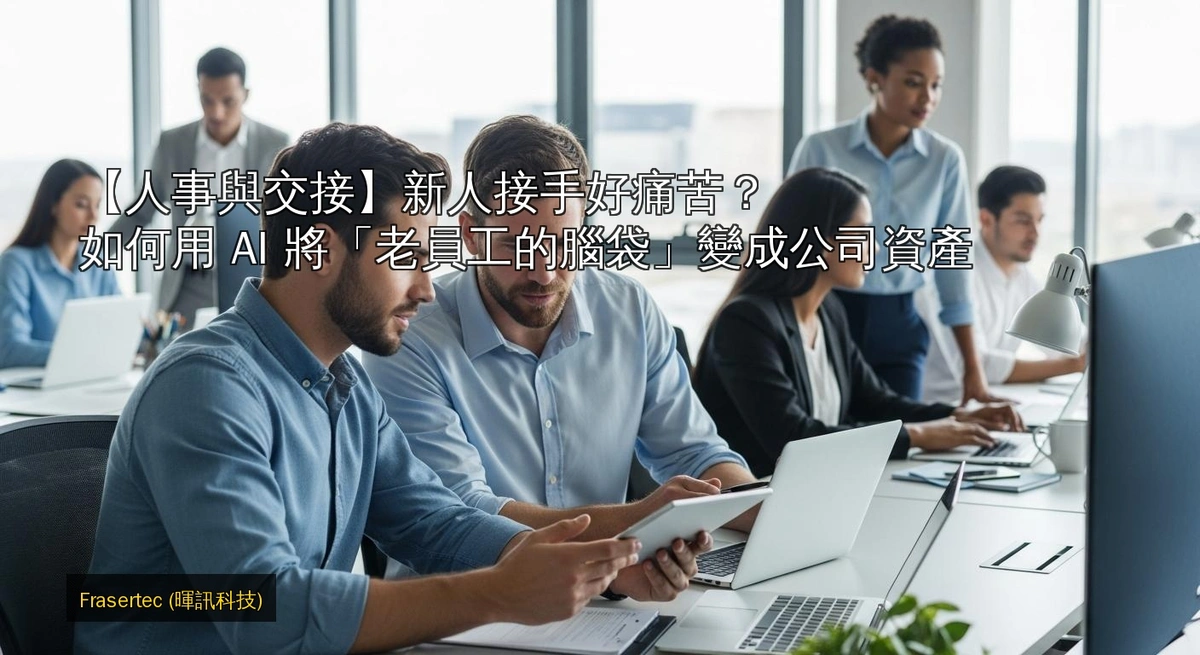
Is it painful for newcomers to take over? How to use AI to turn "senior employees' brains" into company assets
New Hires Struggling? How to Turn Senior Employees' Knowledge into a Company Asset with AI
"Hey John, about that project we were discussing with ABC Company, where's the final version of the quotation? What was the client’s main concern?"
"Uh... Mary, who was handling that project, left last month... It doesn't seem to be in her handover list..."
This kind of conversation is all too familiar in many Hong Kong SME offices. Every time a senior employee leaves, it feels like a small earthquake. New hires, faced with messy files, scattered email threads, and a handover list that might already be outdated, often feel lost and helpless, with their productivity taking a serious hit. The most painful part is that the truly valuable "hands-on experience" and "networks" are usually locked inside the veteran's head, and they walk out the door along with them.
For Hong Kong SMEs operating on tight resources, the cost of this knowledge gap is particularly high. It not only slows down new employees' onboarding pace and affects project progress, but can also damage client relationships and ultimately weaken the company's core competitiveness. Do we have to just watch these invaluable intangible assets drain away? In fact, with the maturity of artificial intelligence (AI) technology, a new solution has emerged: turning the "veteran's brain" into an asset the company can own and pass on permanently.
The Real Challenge of Handovers: "Tacit Knowledge" That's Hard to Put into Words
To solve the problem, we must first understand its root cause. The difficulty of personnel handovers isn't because those obvious, practical tasks are hard to teach. What's truly tricky is the "tacit knowledge" that's difficult to document. This includes:
- Client subtext: Which client prefers you to get straight to the point? Which one needs more small talk? When they say "I'll think about it," do they really mean it, or is it a polite decline?
- Project unwritten rules: What was the decision-making process for a certain project? Why was Plan A chosen over Plan B? What kind of cross-departmental coordination and compromise was involved?
- Problem-solving intuition: Faced with an emergency, senior employees can quickly pinpoint the root cause based on experience. Where does this "sixth sense" come from?
- Informal networks: "For any technical issues, the fastest way is to talk to Peter in IT." "If you need to secure a budget, give Amy in Finance a heads-up first."
This knowledge is the accumulated experience, intuition, and wisdom gained over years on the job. Traditional handover methods, like writing handover notes or arranging shadow training with a mentor, often have limited effect.
- Limitations of the handover list: When leaving employees are busy clearing leave and tying up loose ends, they rarely have the motivation to write down every detail. What they do write is often just the tip of the iceberg.
- Shortcomings of shadow training: The "master" may not know how to teach, or may not be willing to teach everything. The "apprentice" might also hesitate to ask "stupid questions" out of politeness. Moreover, in Hong Kong's fast-paced work environment, carving out significant time for one-on-one training is a luxury in itself.
As a result, new hires can only "figure it out on the fly," using time and mistakes to relearn knowledge that should have been passed down. This is undoubtedly a huge waste of company resources.
How AI Acts as a "Corporate Brain" to Preserve and Transfer Knowledge
The power of AI lies in its ability to process and understand massive amounts of unstructured data—the countless emails, meeting notes, chat messages, reports, and documents we generate in daily work. By implementing an AI knowledge management system, companies can build a "Corporate Brain" that never resigns and is available 24/7.
This process can be roughly broken down into three steps:
Step 1: Comprehensive Knowledge Capture
First, the system automatically integrates and digests various internal information sources. This is not limited to files on the server; it can also include:
- Email correspondence: Automatically archive emails exchanged with clients and suppliers.
- Meeting notes: Use speech-to-text technology to automatically transcribe conversations from video or in-person meetings.
- Instant messaging: Integrate conversation logs from internal communication tools such as Microsoft Teams and Slack.
- Digitised documents: Use optical character recognition (OCR) technology to scan and convert old paper documents, contracts, invoices, etc., into searchable digital text.
Step 2: Intelligent Knowledge Organization
After capturing the vast amount of data, the AI acts like a super librarian, automatically classifying, tagging, and indexing this messy information. It can identify keywords, project names, client companies, people's names, and analyse the relationships between them, building a structured knowledge network. For example, the AI can automatically link together all emails, meeting notes, and quotations related to "ABC Company 2025 Renewal Project."
Step 3: Human-Friendly Knowledge Retrieval
This is the most revolutionary step. Employees no longer need to search for a needle in a haystack within a maze of folders. They can simply "ask" the AI system in the most natural way.
Summarise all the key interactions we've had with ABC Company over the past year, and what their most important service concerns were.
The AI system will instantly search the entire corporate knowledge base, sifting through thousands of emails and meeting notes to produce a clear summary report. The report might say: "ABC Company complained about system response time during a meeting in March last year, and praised our after-sales support in a September email. Their main concerns are data security and system stability."
This kind of interaction allows new hires to grasp in minutes the client insights that their predecessor spent years accumulating, enabling a truly "painless handover."
Practical Applications for Hong Kong SMEs
Integrating AI into knowledge management is not a distant tech fantasy; it is a practical tool that can immediately benefit SMEs:
- Super Onboarding Assistant: Equip each new hire with an AI Chatbot. Whether they need to know how to claim medical insurance, where project files are stored, or "who handles payroll," the AI can answer instantly, greatly reducing the burden on HR and direct supervisors.
- "Memory Booster" for Sales and Customer Service Teams: Before meeting a client, sales staff can quickly look up that client's transaction history, past complaints, and even the personal preferences of decision-makers. When a customer service agent receives an inquiry, the AI can instantly provide relevant solutions or cases, ensuring service quality remains consistent regardless of the individual.
- Knowledge Continuity in Project Management: If a project manager leaves mid-project, the new person in charge can ask the AI about the project's historical decisions, risk assessments, and key stakeholder communication points, ensuring the project proceeds smoothly and avoiding delays or errors due to personnel changes.
For Hong Kong SMEs with lean teams and employees juggling multiple roles, building such a knowledge management system is clearly of great importance. It transforms individual capabilities into organisational capabilities, reduces the operational risks associated with losing key employees, and helps the company remain stable and efficient even in a fiercely competitive talent market.
Take Action Now: Turn Knowledge into an Asset
Employee turnover is an unavoidable reality of business, but knowledge loss is an operational risk that can be managed. Investing in an AI knowledge management system is not just about solving today's handover challenges; it's about paving the way for your company's long-term development. It can solidify employee wisdom into a permanent company asset, building an organisation that learns continuously and evolves, ultimately creating a competitive advantage that is hard to replicate.
Keeping the "veteran's brain" in the company is no longer a pipe dream. Take the crucial step in digital transformation today and make AI your most powerful knowledge transfer partner. Frasertec Limited has extensive experience and is dedicated to providing tailor-made AI solutions for Hong Kong SMEs, helping you easily master knowledge management and turn challenges into opportunities.
Contact Frasertec Limited Now
Want to learn more about using AI to build your "Corporate Brain"? Feel free to contact our expert team for a free consultation.
- 📞 Phone: +852 2578 8828
- WhatsApp: 852 25788828
- 🌐 Website: https://www.frasertec.com