The AI Bill Jumped. IT Cannot Map Which Agent Run Cost What
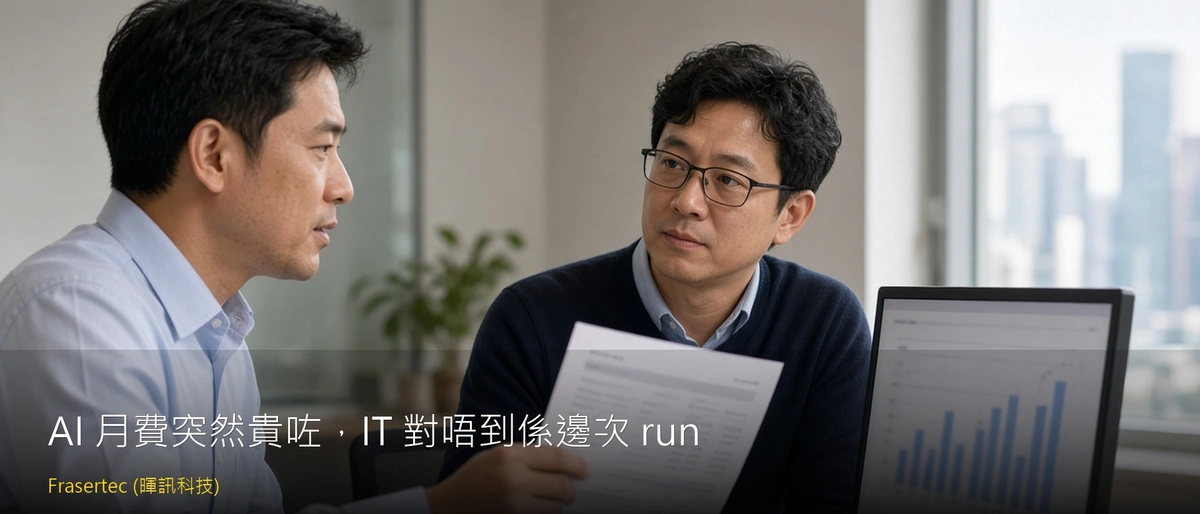
First week of the month, Finance screenshots the invoice and drops it straight into IT's WhatsApp: "Copilot consumption spiked again, and here comes another Azure token invoice. Why is the total running this high?" IT opens the dashboard and sees Sales spent all last week prompting Copilot and Gemini to churn out dozens of shipping notes and quotation drafts—every revision quietly burning tokens. Worse, staff are quietly using personal ChatGPT accounts over VPNs to polish client proposals, leaving corporate pricing exposed while IT gets zero visibility on company spend. The boss walks past: "Wasn't generative AI supposed to cut operational headcount? We can't even get official enterprise ChatGPT in Hong Kong, so why are our legitimate cloud subscriptions suddenly bleeding money?"
The invoice total is painfully clear, but the backend doesn't trace a single dollar back to a specific sales order. Prompts are lumped together in one massive cloud ledger, making it impossible to tell which run generated profit and which run just burned tokens.
Buying a few extra user seats or asking IT to maintain a departmental quota spreadsheet won't fix this. When the next bill lands, management is still left guessing whether those API calls drove genuine pipeline or simply paid for staff testing random prompts.
Bind One Agent to One Workflow to Anchor Model Consumption to Real Business Output
Enterprise AI should never mean handing staff an open-ended chatbot prompt and hoping for productivity. Instead, model usage must be constrained to clear, repeatable business tasks. Through Frasertec Limited's AI Agent development services, discrete workflows like quotation generation or delivery note reconciliation are assigned to dedicated agents, seamlessly integrated via AIWorkflow with complete execution logging and precise cost attribution.
Dedicate One Agent to a Specific Workflow
Do not let team members improvise with unstructured chatbots. Confine each agent to a singular task—such as cross-checking delivery notes against purchase orders or assembling initial quotation drafts. Restricting data inputs to required fields alone drastically curtails unnecessary token drain.
Log Transaction IDs and Exact Run Costs
Every time an agent invokes Azure OpenAI or cloud models, the backend automatically logs execution timestamps, the associated SO number, and exact token costs. When Finance reconciles invoices at month-end, every cloud dollar is mapped directly to commercial output.
Route Price Adjustments and Dispatch to Human Review
Routine extraction and data reconciliation achieve 85% to 95% accuracy out of the box. However, whenever discounted pricing, stock shortages, or exceptional delivery terms are flagged, the agent routes the draft to a supervisor for mandatory review and final approval.
Build Accountable Digital Employees with Transparent Run Costs
Bring clarity to cloud AI spending and turn automation into verifiable operational return. Contact the Frasertec Limited consulting team to architect a structured workflow for your business.
WhatsApp 852 25788828Hong Kong businesses cannot access official ChatGPT Enterprise directly. How can we deploy enterprise-grade GPT models compliantly?
Hong Kong enterprises can leverage Microsoft Azure OpenAI as an enterprise-grade, compliant gateway. When Frasertec Limited builds custom AI agents, client data can reside in Hong Kong or designated compliant regional data centers, ensuring proprietary corporate data is never used to train public foundation models.
How long does it take to develop and integrate a production-ready AI agent?
A single-workflow proof-of-concept (POC) typically takes 4 to 8 weeks. For end-to-end integration with existing ERP, CRM, or accounting systems alongside comprehensive validation, a complete production deployment generally requires 6 to 10 weeks.