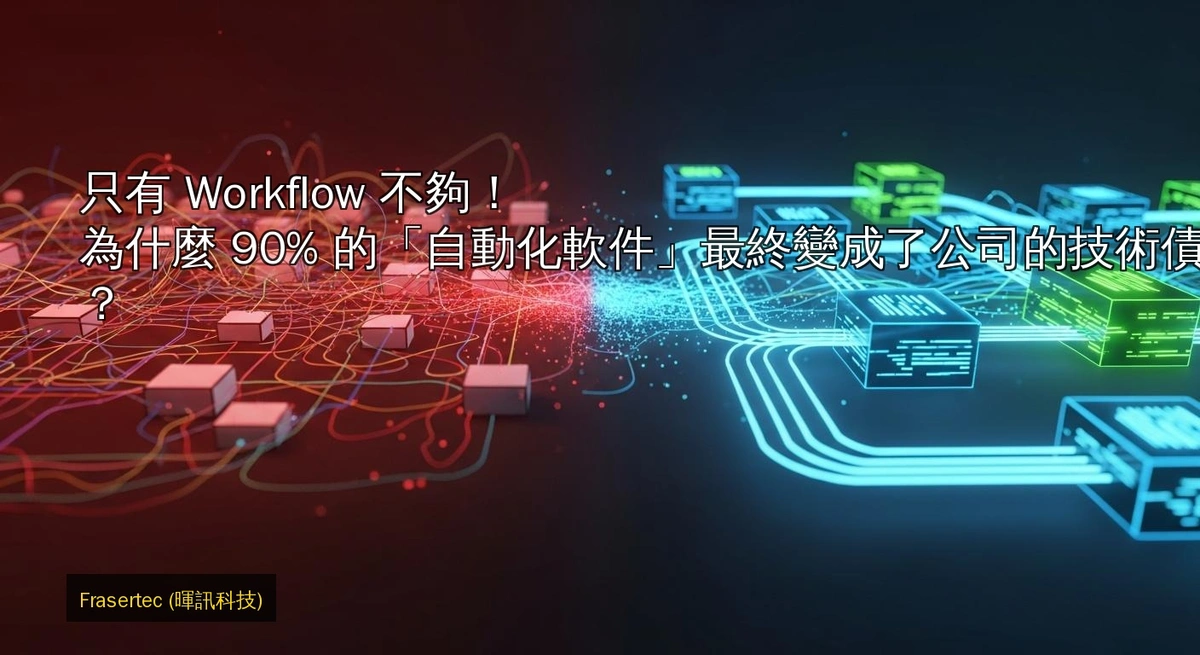
Workflow Alone Isn't Enough! Why Do 90% of 'Automation Software' End Up as Technical Debt for Companies?
In the wave of digital transformation, every owner and manager of Hong Kong's small and medium-sized enterprises (SMEs) has "automation" on their lips. The goals are clear: reduce human error, save operational time, and free the team from repetitive, trivial tasks to focus on more valuable work. Consequently, various "No-Code" or "Low-Code" automation tools on the market, such as Zapier, Make, etc., have become a "quick fix" for many companies. These tools promise that with just a few simple clicks, you can connect the apps you use daily (e.g., Gmail, Google Sheets, Slack) to build an "automated workflow." Initially, the effects are indeed immediate: a new order email triggers the system to automatically add a row to a spreadsheet; a customer submits a website form, and the team gets instant notification on a communication app. It feels like entering a new era of efficiency, everything seems perfect.
However, this "honeymoon period" is usually short-lived. Based on our experience and industry observation, up to 90% of companies, one or two years after embracing such simple Workflow tools, not only fail to enjoy sustained efficiency gains but instead sink into a deeper mire—Technical Debt. What seemed like a clever shortcut eventually turns into a complex, incomprehensible time bomb, ready to "explode" at any moment. This article will deeply analyze why relying on Workflow alone is absolutely insufficient and how it gradually evolves into technical debt that hampers company operations.
The First Step Misconception: Workflow Automation vs. True Business Process Automation (BPA)
To understand the root of the problem, we must first distinguish between two completely different concepts of "automation":
- Workflow Automation: This is akin to using "duct tape and cable ties" to solve a problem. Its core logic is "If This, Then That." For example, if a Gmail is received, copy its content to Airtable. The advantages of this method are simplicity, speed, and low barrier to entry—almost anyone can set it up with minimal effort. It focuses on connecting two independent points to solve a single, linear task.
- Business Process Automation (BPA): This is equivalent to hiring professional engineers and architects to plan and build a genuine "highway." The goal of BPA is not merely connecting point A to point B, but re-evaluating and optimizing the entire business process, then using technology to systematize and scale it. It considers not just triggers and actions, but also data validation, error handling, permission management, database structure, user interface (UI), and future scalability. This is a comprehensive systems engineering project, not just a "point-to-point" connection.
Most Hong Kong SMEs, due to limited resources and a pursuit of immediate results, often choose the former. They think they are "doing automation," but in reality, they are just using digital duct tape to haphazardly glue together individual processes that may already be problematic. And this is precisely the beginning of technical debt.
Tallying How Workflow Gradually Accumulates into Your "Technical Debt"
"Technical Debt" is a term from the software development field, meaning that adopting a limited or expedient solution for short-term speed leads to requiring more time and cost in the future to fix and refactor. Here's how simple Workflow tools plant these "debts" for your company:
1. Fragile "Breakpoints": Extreme Lack of Stability and Scalability
The connection of Workflows is like a chain, and its strength depends on the weakest link. If the developer of one app updates its API, changes its pricing model, or even if a colleague accidentally changes a column name in a Google Sheet, the entire automation chain can break instantly without any warning.
Real Case: A local e-commerce company used a Workflow to automatically sync Shopify orders to Google Sheets, which were then processed manually by accounting staff. During a "Double Eleven" promotion, daily orders surged from a few dozen to over a thousand. As a result, the API call limits of the Workflow tool were exceeded, causing severe system delays or complete failure. A large number of orders couldn't be processed promptly, leading to customer complaints, shipping chaos, and damage to both company reputation and revenue. This is a classic consequence of lacking scalability.
2. "Data Silos" and Inconsistency: A Nightmare for Reporting
Simple Workflows typically just "copy and paste" data in one direction; they cannot ensure data remains synchronized and consistent across multiple systems. When data is updated in System A, the old data in System B does not automatically change. Over time, multiple versions of the "truth" emerge within the company, and no one knows which data is most accurate.
For example, the sales team updates a client's contact details in the CRM, but the old information in the finance system remains untouched. When the finance department sends invoices based on the old data, it causes delays and customer dissatisfaction. Want to create an accurate sales report? You might need to manually cross-check data from three or four different spreadsheets—completely negating the original purpose of automation.
3. Lack of Transparency: Becoming an Unmanageable "Black Box"
When you only have two or three Workflows, managing them is relatively easy. But as the business grows, a company might build dozens or even hundreds of Workflows spanning different departments. These Workflows intertwine and trigger each other, forming an extremely complex network. The problem is, the management interfaces for these tools are usually very rudimentary, lacking sufficient monitoring and logging functionality. When a process fails, it's difficult to trace the root cause to a specific link. The entire automation system becomes a "black box," running seemingly fine, but leaving you helpless when something goes wrong.
4. "Key Person" Risk: One Colleague Leaves, the Whole System Crashes
In SMEs, these Workflows are often handled single-handedly by one colleague with a greater passion for technology (the "key person"). He or she might be the only one who fully understands how this complex network operates. This creates a massive operational risk: If this colleague leaves, who takes over? Without documentation, without systematic knowledge transfer, all that's left is a pile of incomprehensible "digital legacy." New colleagues are afraid to touch it for fear of breaking it; the boss wants to optimize processes but finds no starting point. Ultimately, the company is "held hostage" by the automation system it created, stuck between a rock and a hard place. This "endless hassle" dilemma is one of the heaviest forms of technical debt for SMEs.
5. Security and Compliance Vulnerabilities: An Invisible Bomb You Can't Ignore
For convenience, employees might authorize logins to the company's core systems—such as email, cloud storage, or even customer databases—on various third-party Workflow platforms. Have you carefully considered: Is this sensitive data sufficiently secure during transmission? Do these platforms comply with Hong Kong's Personal Data (Privacy) Ordinance (PDPO) requirements? The consequences could be disastrous if one of these platforms is hacked.
Beyond Workflow: The Right Mindset for Sustainable Automation
Reading this, you might ask, "Does this mean we shouldn't use these tools at all?" The answer is no. Workflow tools are excellent Proof of Concept (PoC) instruments that can help you quickly test an automation idea. However, to use them as the core of long-term company operations, a more professional and strategic approach is essential.
- Process First, Technology Second: Automating a chaotic process only yields "automated chaos." Before introducing any technology, sit down with your team to thoroughly review, simplify, and optimize existing business processes. The consultant team at Frasertec Limited can help you map these processes and identify the real bottlenecks.
- Establish a "Single Source of Truth": A robust system must be designed around a central database or core system to ensure data accuracy and consistency. Whether it's a Customer Relationship Management (CRM) system, an Enterprise Resource Planning (ERP) system, or a custom-built database, it should become the sole, reliable source for all your business data.
- Consider Long-term Scalability & Maintainability: When choosing a solution, don't just "cut your coat according to your cloth." Ask yourself: In two years, when my business volume grows tenfold, can this system still cope? Is there clear documentation and logging? Is it easy to hand over to new colleagues? A good system should be like a quality machine, with clear manuals and a maintenance plan.
How Frasertec Limited Helps You Shed Technical Debt and Build Real Assets
Simple Workflows are like renting temporary tools, while Frasertec Limited is about building a custom-made, durable "machine" for you. We understand the dual needs of SMEs for cost and efficiency. Therefore, what we offer is not a single software product, but a complete solution set:
- Business Process Consulting Services: We first gain a deep understanding of your business pain points, helping you redesign and optimize processes to ensure automation delivers maximum value.
- Custom System Development: We develop stable, secure, and scalable business systems (e.g., CRM, ERP, internal operational platforms) for you, systematizing your core processes and completely freeing you from reliance on fragmented tools.
- Professional System Integration: We seamlessly connect your existing software (accounting, inventory, website, etc.) to your core system in a robust and reliable way, building an efficient, collaborative digital ecosystem.
- Long-term Technical Support & Maintenance: We provide ongoing support and maintenance to ensure your system evolves with the times, eliminating your worries about the "key person" risk.
The original purpose of automation is to create assets for the company, not accumulate liabilities. If you find your company's automation attempts are spiraling out of control, or if you're preparing to embark on the automation journey but don't know where to start, don't hesitate any longer. Short-term "convenience" may lead to long-term pain. It's time to make the right choice and build a truly value-adding automation foundation for your company.
Contact Frasertec Limited now for a professional process assessment, helping you chart a successful automation path free of "technical debt."
📞 Phone: +852 2578 8828
🌐 Website: https://www.frasertec.com
Contact us on WhatsAppFor more insights, check out our related blog post: Stop Letting Spreadsheets Be Your Company's Stumbling Block: 3 Signs It's Time to Upgrade Your Internal Systems.